
What was the OpenAI Builder Lounge Sydney event?
The OpenAI Builder Lounge in Sydney was a builder-focused session held on 19 March 2026 at Stone & Chalk Tech Central Innovation Hub in Haymarket. According to the event listing, OpenAI's APAC startup team partnered with Stone & Chalk to bring together founders and developers doing real work on the platform, with frontier model updates, demos, technical discussion, and working time with the OpenAI team.
Stone & Chalk's own recap described the session as a full house with live demos, technical deep dives, and honest conversations about what teams are actually building. Pinksheep was part of that showcase, and the photo below is from the live presentation.
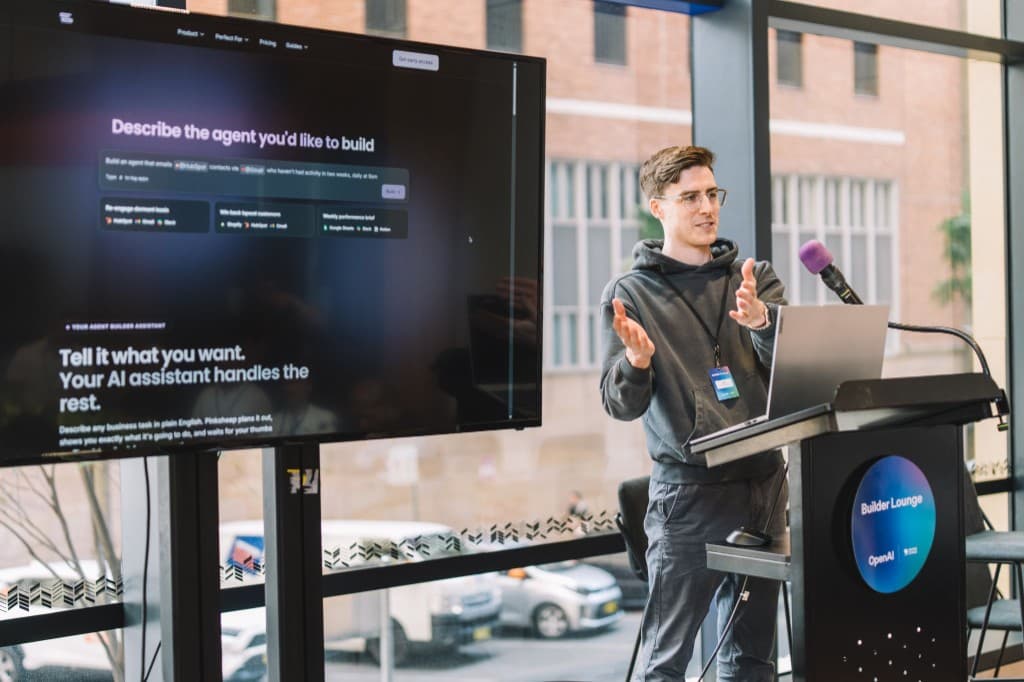
Event
OpenAI Builder Lounge - Sydney
Hosted with
OpenAI and Stone & Chalk
Venue
Stone & Chalk Tech Central Innovation Hub, Haymarket
What I showed on stage
The showcase was not about a generic claim that AI agents are coming. It was about the practical rollout problem that companies are already running into right now. Most growing organizations know they should be introducing AI, but they are struggling to get from interest to safe, repeatable adoption.
The message was simple: the barrier is rarely model capability. The barrier is rollout design. If the business needs specialized AI or agent teams just to get basic deployment moving, most companies will stall long before agents become normal day-to-day tools.
- AI ambition is real, but rollout is fragmented.
- Non-technical users want outcomes, not another internal ticket queue.
- Safety matters, but safety cannot depend on permanent engineering babysitting.
- Adoption increases when governance is built into the product instead of bolted on later.
Why AI agent rollout is still hard for growing teams
Smaller and mid-sized companies are in an awkward position. They feel pressure to adopt AI quickly, but they do not usually have a dedicated internal AI team, a large platform group, or extra headcount to translate every business workflow into an agent spec.
That leaves them trying to introduce agents through generalist technical resources, external consultants, or a small operations lead who has to carry too much context. The result is usually the same: a handful of demos, maybe one or two narrow pilots, and then a long stall when the maintenance burden shows up.
| Pressure | What teams actually face |
|---|---|
| Leadership urgency | A push to roll out AI across the business without a dedicated AI operating function. |
| Tool complexity | Agent platforms often assume technical setup, custom logic, or hands-on maintenance. |
| Governance risk | Teams worry about unsafe writes, uncontrolled spend, unclear ownership, and missing audit history. |
| User adoption | Non-technical operators are left waiting on internal experts instead of using AI directly. |
Why the top-down rollout model is the real bottleneck
The deeper issue is how most companies are framing the rollout problem. They try to introduce AI agents from the top down through a tech team, outside specialist, or a small group of technical people. That sounds sensible until you look at what it asks those people to do.
It asks them to understand the operating reality of every department, translate those business problems into workable agent logic, maintain those agents over time, and somehow keep that context current as the business changes. That is too much translation load for a thin layer of resources to carry.
This is why agent programs often feel promising at the start and fragile later on. The business dependency stays centralized. Every new workflow, edge case, approval rule, and maintenance request still has to come back through the same scarce people.
| Model | Who holds the context | What breaks first |
|---|---|---|
| Top-down rollout through tech or consultants | A small technical layer has to interpret every business problem. | Speed, maintenance capacity, and adoption outside the first pilot. |
| Governed self-serve rollout through Pinksheep | Operators define their own problems within a controlled platform. | Scope stays intentionally narrow at first, then expands safely over time. |
How Pinksheep lowers the barrier to adoption
Pinksheep is built around a different tradeoff. Instead of trying to maximize scope on day one, it trades scope for engagement and adoption. Teams start with governed agents that are easier to understand, easier to approve, and easier to own.
That means people do not have to route every idea through a tech team. With a no-code agent builder, operators can describe the job, review the plan, and deploy governed agents inside the business tools they already use. Through the mobile app, users can interact with and manage those agents themselves instead of waiting on a specialist queue.
Senior leadership gets what they actually need from an AI rollout: clear governance, gradual expansion, and a way to demonstrate that agents are being introduced safely. Scope can grow over time as usage, confidence, and controls mature. It does not need to be fully solved up front.
- No-code builder so technical and non-technical users can participate.
- Governed deployment so approvals and review stay in front of risky actions.
- Mobile access so users can interact with and manage agents in day-to-day work.
- Gradual scope expansion so the business does not depend on permanent specialist mediation.
Why the cultural effect matters as much as the technical one
There is also a major cultural upside to this rollout model. When AI is introduced as something controlled only by technical specialists, people can easily feel that the business is trying to replace them with systems they do not understand.
When the same rollout is framed as governed self-service, the feeling changes. People are not being sidelined. They are being equipped. They use AI themselves, shape how it helps their team, and stay involved in approvals and day-to-day operation.
That is good for adoption because it turns AI from an outside threat into an internal tool. Tech teams stop looking like the people pushing replacement. They look like the people enabling safe capability across the business.
Frequently asked questions
What was the OpenAI Builder Lounge in Sydney?
The OpenAI Builder Lounge in Sydney was a builder-focused session held at Stone & Chalk Tech Central on 19 March 2026. The event listing described it as an afternoon for founders and developers building on OpenAI's platform, with model updates, demos, technical discussion, and working time with the team. OpenAI's APAC startup team partnered with Stone & Chalk on the session.
What was Pinksheep's main point at the event?
The core point was that many growing companies do not fail on AI ambition. They fail on rollout model. When every agent request has to pass through a small technical team or outside consultant, adoption stays narrow, translation quality drops, and long-term ownership never gets solved.
Why is top-down AI agent rollout so hard for non-technical teams?
Top-down rollout assumes technical resources can understand each department's operating context well enough to define, maintain, and improve agents for everyone else. In practice that creates a translation bottleneck, slows iteration, and leaves non-technical users dependent on a scarce internal service function.
How does Pinksheep lower the barrier to AI agent adoption?
Pinksheep lowers the barrier by trading scope for adoption. Teams start with narrower, governed agents instead of trying to automate everything at once. Non-technical operators can build and run agents through a no-code interface, use a mobile app to manage them day to day, and stay inside approval and governance controls set by the business.